
Download
Cox value = 1 × 16 : 1 % + 18 : 1 + 20 : 1 % + 10.3 × 18 : 2 % + 20 : 2 % + 21.6 × 18 : 3 % 100 2



Research Article
Quality parameters during deep frying of avocado oil and extra-virgin olive oil
Marcos Flores1*, Claudia Vergara2, Tamar Toledo-Aquino3, Jaime Ortiz-Viedma4*, Jorge Barros-Velázquez3
1Departamento de Horticultura, Facultad de Ciencias Agrarias, Universidad de Talca, Campus Lircay, Talca, Chile;
2Departamento de Ciencias Básicas, Facultad de Ciencias, Universidad Santo Tomás, Avenida Carlos Schorr 255, Talca, Chile;
3Analytical Chemistry, Nutrition and Food Science, College of Pharmacy/School of Veterinary Sciences, University of Santiago de Compostela, Campus Vida, Santiago de Compostela, Spain;
4Departamento de Ciencia de los Alimentos y Tecnología Química, Facultad de Ciencias Químicas y Farmacéuticas, Universidad de Chile, Casilla, Santiago, Chile
Abstract
Avocado oil has a good thermal stability. However, there is a lack of knowledge about the behavior when hydrolysis is involved with oxidation processes. This study demonstrated potential for deep frying process of avocado oil. The behavior of cold-pressed olive oil and avocado oil in a domestic frying process with natural potatoes was studied. Both oils were subjected to successive frying cycles and the following chemical properties were analyzed: degree of acidity, peroxide value, p-anisidine value, total oxidation (TOTOX) value, polar compounds, total phenolic content, Fourier-transform infrared spectra with attenuated total reflectance, and fatty acid profile. A gradual increase was observed in the degree of acidity, p-anisidine, TOTOX, polar compounds but a decrease in total phenolic content during deep-frying period for both oils. It was determined that avocado oil and olive oil take 10 and 13 days of frying cycles, respectively, to reach the limit value of 25% for polar compounds. It was demonstrated that both vegetable oils are suitable for domestic frying processes, enduring a high number of deep-frying cycles before reaching the limit of polar compounds established by health regulations, despite the generation of oxidation and hydrolysis processes.
Key words: avocado oil, olive oil, frying process, thermal stability, polar compounds, total phenols
*Corresponding Authors: Marcos Flores, Departamento de Horticultura, Facultad de Ciencias Agrarias, Universidad de Talca, Campus Lircay, Talca 3460000, Chile. Email: marcos.flores@utalca.cl; Jaime Ortiz-Viedma, Departamento de Ciencia de los Alimentos y Tecnología Química, Facultad de Ciencias Químicas y Farmacéuticas, Universidad de Chile, Casilla 233, Santiago, Chile. Email: jaortiz@uchile.cl
Received: 10 September 2024; Accepted: 26 September 2024; Published: 30 October 2024
© 2024 Codon Publications
This is an Open Access article distributed under the terms of the Creative Commons Attribution-NonCommercial-ShareAlike 4.0 International (CC BY-NC-SA 4.0). License (http://creativecommons.org/licenses/by-nc-sa/4.0/)
Introduction
Avocado (Persea americana) is produced in various parts of the world, with the countries of the American continent being the largest global producers (>70%) (Food and Agriculture Organization [FAO], 2022). Avocado oil (EVAO) is relatively new and highly appreciated by consumers because of its beneficial properties for health (Tan, 2019). EVAO has a high percentage of monounsaturated fatty acids (MUFAs), followed by saturated fatty acids (SFAs) and a lower proportion of polyunsaturated fatty acids (PUFAs), in addition to the presence of antioxidant components, such as phenolic compounds, tocopherols, and sterols (Flores et al., 2019).
Avocado oil has shown good behavior against thermal deterioration processes, compared to unrefined oils, such as extra-virgin olive oil (EVOO), a characteristic that is related to a low content of PUFAs, a high content of MUFAs, such as oleic acid, and content of total polyphenols (Forero-Doria et al., 2017; Moura et al., 2023). Even EVAO does not show major changes in its fatty acid composition when it undergoes refining process (Satriana et al., 2024). On the other hand, refined oils are enriched with variable proportions of unrefined oils because of their high content of bioactive compounds during frying temperatures, research that could be the basis for another type of frying with beneficial effects on health (Fedko et al., 2024). In literature, there is a permanent search for new sources of oils that can be resistant to high temperatures, especially if they are cold-extracted oils, where advanced heating techniques demonstrate that these cooking media could be useful at frying temperatures (Correa et al., 2024). In addition, traditional frying process becomes an important comparative method to improve nutritional and technological properties, such as flavor and other attributes (Cheng et al., 2024).
However, there is a lack of knowledge about the behavior of EVAO during deep frying processes, where the oil is in direct contact with foods that transfer moisture and other components to the oil, as well as the migration of lipid compounds from the frying medium to the fried product, thus improving the nutritional quality of the final product (Fedko et al., 2024). Oils that have PUFAs, such as linoleic fatty acid and linolenic fatty acid in high proportions are suitable for raw consumption because of their nutritional properties (Kapoor et al., 2021). Furthermore, PUFAs are unstable when subjected to high temperatures, even generating toxic compounds (Tsai et al., 2023). Additionally, in certain population groups, dietary intake of SFAs is associated with multi-cause mortality, and decreasing dietary intake of SFAs could increase survival rates in these vulnerable groups (Zheng et al., 2023). Therefore, the choice of oil with an adequate proportion of fatty acids and bioactive components, as well as the conditions of the frying process, is essential for the thermal stability of oils and the quality of the fried product (Téllez-Morales et al., 2024).
Frying process is a very old culinary process that has been evidenced in Egyptian wall paintings describing a dough frying process; these representations show frying as a method of food preparation long before the current era of frying (Stier, 2004). This is a food preparation process used widely to the present day globally. It consists of immersing raw food in hot oil until it is cooked, providing the organoleptic characteristics desired by consumers (Li et al., 2018). The heat from the oil is transmitted to the food through convection, and within the food, it is conducted by conductivity. Water vapor generated inside the food migrates outward, influencing the formation of the outer layer and interacting with the surrounding oil (Rodríguez et al., 2021). The factors that affect the performance of oil during the frying process are categorized into two groups: (1) external factors, such as frying time, frying temperature, presence of oxygen and type of fryer, and variables that are manipulated by an operator, and (2) internal factors that involve the composition of major and minor components of oil. Both types of factors are relevant for the performance of frying process (Aladedunye, 2011). Using unrefined edible vegetable oil in culinary processes can avoid the intake of synthetic antioxidants, such as butylated hydroxyanisole (BHA), butylated hydroxytoluene (BHT), and tert-butylhydroquinone (TBHQ), which have been linked to adverse effects on human health (Arabsorkhi et al., 2023).
For a frying process, a series of complex chemical reactions are documented, such as polymerization, oxidation, and hydrolysis of triacylglycerides, which result in toxicological and nutritional consequences (Asokapandian et al., 2019; Dobarganes and Márquez-Ruiz, 2007). Therefore, the level of deterioration of oils subjected to frying processes must be determined compulsorily.
However, using unrefined oils, such as EVAO, in deep-frying processes can positively impact the composition of fried foods through compound migration. This results in the enrichment of fried foods with biologically active components, such as sterols and unsaturated fatty acids (Samaniego-Sanchez et al., 2021).
Some methods used to determine the quality of oils during the frying process include peroxide value (PV), triglyceride polymers (TGP), polar fatty acids (PFA), fatty acid composition, and polar compounds (PCs). Among these, PCs are a robust indicator and are widely used in various international regulations, with a maximum allowed value of 25 wt% (Flores et al., 2018; Holgado et al., 2021; Sánchez-Muniz et al., 2008).
The present study aimed to explore the deep-frying process behavior of extra-virgin EVAO and compare it with extra-virgin EVOO mimicking domestic preparation conditions.
Materials and Methods
Frying test
Both EVAO and EVOO, labeled as extra-virgin oils, were purchased from the local market in the city of Talca, Chile. Both oils were subjected to a prolonged period (≥10 days) of discontinuous heating at 180°C ± 5°C in a 2.5-L Somela domestic fryer (model: deep-fryer df535t; dimensions: height 280 mm × width 375 mm × depth 315 mm). The frying process consisted of a cooking session of 200 g of potato in each oil for a period of 10 min with food and 5 min without food, repeated for four times each day, for a total period of 60 min with the oil at 180°C every day, where a frying cycle matched with the end of each study day. The hot oil was stored in the switched off fryer at room temperature until the next study day. The potatoes were cut using a household potato slicer in the shape of a stick, with a side of 10 mm. These were then added to an initial volume of 2.1 L of each oil, without replacement or addition of fresh oil. The frying process was applied every 24 h, imitating domestic conditions. Sufficient volume of oil was extracted from the frying medium of the fryer for analysis after four frying sessions on each study day. Each analysis was evaluated in triplicate. The samples were stored in amber-colored bottles and kept in a refrigerator (4 ± 1°C) for further analysis.
Analytical determinations
Chemical analysis. An initial fatty acid profile of both EVAO and EVOO was determined using a gas chromatograph (Model 5890 Series II; Hewlett Packard), which was equipped with a split/splitless injector with automatic sampler and flame ionization detector. Methyl esters to be injected were obtained using methanolic potassium (2 N). The capillary column used by the system was SP2380 (30-m long, 0.25-mm internal diameter, and 0.20-µm film thickness). The carrier gas was hydrogen, with a flow rate of 1 mL/min. Injector and detector temperatures were kept at 220°C and 250°C, respectively. The initial oven temperature was 180°C, and the gradient temperature ranged from 180°C to 220°C (at 3°C/min). The injected volume was 1 µL. The injection volume was used. more details are described elsewhere (Ourrach et al. 2012). Oil quality parameters (i.e., free acidity, peroxide value [PV], and p-anisidine values [p-AV] were determined according to the analytical methods described in the European Commission Regulations. Total oxidation values (TOTOX) were calculated as follows (Farhoosh et al., 2009):
TOTOX = 2PV + p-AV, (1)
Total PCs were determined using an electrochemical sensor (Testo 270; Testo AG, Lenzkirch, Germany). The results obtained are represented as mean + standard deviation of at least three replicates.
Reagents and standards. p-anisidine reagent and analytical solvents were acquired from Merck-Chile. Potassium iodide and sodium thiosulfate were obtained from Winkler Ltd. (Santiago, Chile).
Calculated oxidizability value (Cox)
The Cox values of oils were calculated as proposed by Fatemi and Hammond (1980). Briefly, the sum of proportions of unsaturated fatty acids is considered, which was multiplied by proportionality factors according to the following equation:
Fourier-transform infrared spectroscopy with attenuated total reflectance (FITR-ATR) of EVAO and EVOO
An FTIR spectrometer (FT/IR-4X model; Jasco Corporation, Japan) equipped with attenuated total reflectance (ATR) sampling device was used to determine the FTIR spectra of both EVAO and EVOO prior to the frying process (ti) and at the end of the frying process (tf). The FTIR spectra was determined in a transmittance range of 4,000–550 cm–1 in mid-infrared mode using the Spectramanager 2.0 software for obtaining and processing the spectra, in conjunction with the OriginPro software for graphic purposes, by following Han et al. (2020) with slight modifications, with a scan for 64 samples and a spectral resolution of 4 cm. The experiments were evaluated at room temperature and the spectra were adjusted using background air spectrum.
Refractive index
Refractive indices of both EVAO and EVOO were determined using a portable refractometer (Yieryi DR-102 digital refractometer; Shen Zhen Yieryl Technology Co., Ltd., Guang Dong, China) at 25°C.
Color measurements
Oil color parameters L*, a*, and b* were measured by handheld colorimeter (DOHO DR18; Shenzhen Three NH Technology Co. Ltd., China).
Statistical analysis
Two-sample t-test for independent data was performed to determine statistically significant differences between samples. The SPSS 19.0 (Statistical Product and Service Solutions) software was used for statistical analysis, and statistical significance level was set at P < 0.05.
Results and Discussion
EVOO is mostly a monounsaturated vegetable oil (>75%), and has shown good performance during different culinary processes, such as deep frying, sautéing, and boiling. Minor components present in oils, such as antioxidant compounds, are important parameters to predict their behavior during thermal and hydrolytic deterioration processes (Pérez-Cordova et al., 2023).
The fatty acid composition of commercial oils EVOO and EVAO is shown in Table 1. It can be observed that EVAO presents a decreasing amount of different fatty acids in the following order—MUFAs, PUFAs, and SFAs—with a high proportion of MUFAs (>68%). On the other hand, EVOO contains decreasing order of fatty acids, as follows—MUFAs, SFAs, and PUFAs—with a high proportion of MUFAs (>76%). During thermal oxidation, it has been shown that PUFAs degrade first, followed by MUFAs and then SFAs (Santos et al., 2002). In this sense, it would be expected that EVAO, since it contains a higher proportion of PUFAs compared to SFAs, should present less stability compared to EVOO.
Table 1. Optical characteristics and methyl ester fatty acid (FAMEs) of EVAO and EVOO.
| Initial fatty acid** | Percentage (%) | |
|---|---|---|
| Avocado oil | Olive oil | |
| C14:0 | 0.05 + 0.002 | 0.03 + 0.001 |
| C16:0 | 13.51 + 0.001 | 12.42 + 0.001 |
| C16:1 ω9 ω7 | 5.4 + 0.004 | 0.92 + 0.003 |
| C17:0 | – | 0.08 + 0.002 |
| C17:1 | – | 0.18 + 0.003 |
| C18:0 | 0.48 + 0.001 | 1.82 + 0.042 |
| C18:1 ω9 | 55.94 + 0.056 | 72.31 + 0.056 |
| C18:1 ω7 | 7.23 + 0.060 | 3.04 + 0.001 |
| C18:2 | 16.13 + 0.012 | 7.67 + 0.002 |
| C20:0 | 0.06 + 0.002 | 0.34 + 0.001 |
| C18:3 | 0.93 + 0.003 | 0.68 + 0.003 |
| C20:1 | 0.17 + 0.003 | 0.33 + 0.001 |
| C22:0 | 0.03 + 0.002 | 0.11 + 0.001 |
| C24:0 | 0.06 + 0.004 | 0.07 + 0.002 |
| Total saturated | 14.19 | 14.87 |
| Total monounsaturated | 68.70 | 76.45 |
| Total polyunsaturated | 17.06 | 8.35 |
| Polyunsaturated/ saturated (P/S) |
1.20 | 0.56 |
| Unsaturated/saturated (U/S) | 6.04 | 5.70 |
| Refractive index (RI) | ||
| Initial refractive index | 1.4668 ± 0.0002 | 1.4663 ± 0.0002 |
| Final refractive index | 1.4677 ± 0.0001 | 1.4673 ± 0.0001 |
| Colorimetric parameters | ||
| L* initial | 2.53 ± 0.46 | 5.85 ± 0.43 |
| a* initial | –0.32 ± 0.16 | –0.64 ± 0.006 |
| b* initial | 4.36 ± 0.76 | 10.07 ± 0.72 |
| L* final | 12.80 ± 0.81 | 10.85 ± 0.75 |
| a* final | 0.82 ± 0.05 | –0.35 ± 0.07 |
| b* final | 1.51 ± 0.01 | 4.28 ± 0.21 |
**As methyl ester.
Additionally, it has been shown in prolonged high-temperature thermal processes applied to unrefined vegetable oils that the ratios PUFAs–SFAs (P/S) and MUFAs–SFAs (M/S) have a tendency to decrease, where the oils presenting higher initial values of these two ratios demonstrate less thermal stability (Flores et al., 2019). In this study, both P/S and M/S ratios have lower values for EVAO, compared to EVOO, with values of 53.3% and 5%, respectively. This could be associated with the higher degree of EVAO unsaturation, a parameter that would serve as a predictive criterion of its thermal behavior. Additionally, refractive index (RI) is a quick measure to determine the physicochemical changes, which increases with deterioration, that vegetable oils undergo. In this case, there are significant differences (P < 0.05) for different samples, that is, fresh oil samples and oil samples at the end of frying process. An increase in RI for both oils is evidenced, where EVAO starts with a higher RI value, compared to EVOO, and ends with a higher value. RI increases due to the presence of compounds, such as free fatty acids, ketones, aldehydes (Aydınkaptan and Mazi, 2017). This behavior correlates well with other indicators, such as total PCs or acidity index, with higher values for EVAO compared to EVOO. According to the comparison of the initial and final L*, a*, and b* parameters of EVAO, during the thermal process, the luminosity increased considerably, becoming lighter, with a slight tendency toward green and red, in addition to a decrease in its yellow hue. These changes could be related to the degradation of oil, in addition to the degradation of chromophore compounds during processing. A similar trend occurred in case of EVOO, where a marked decrease in the yellow hue was observed, which could be associated with a decrease in carotenoids present in the oil.
The Cox value calculated in Equation (2) and based on the fatty acid profile, has been related to higher values, there is a susceptibility to oxidation processes and therefore a lower stability of vegetable oils of different degrees of unsaturation (Abril et al., 2019; Xu et al., 2015). EVOO and EVAO presented Cox values of 1.70 and 2.54, respectively. EVOO presented 33% lower Cox value than that for EVAO, which indicated greater susceptibility of EVAO to oxidation processes.
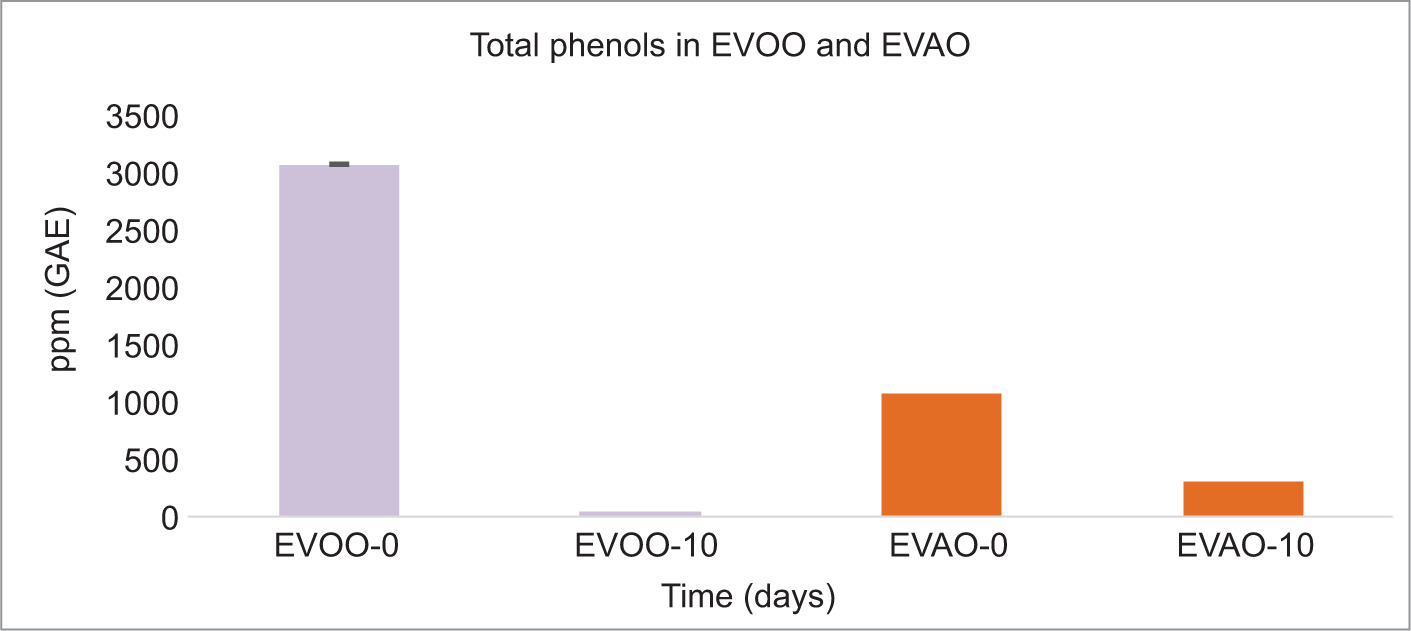
Figure 1 shows the content of total phenols (in ppm gallic acid equivalent [GAE]) determined by the Folin–Ciocalteu method at initial and final processing of both EVOO and EVAO. At the beginning, it was observed that EVOO had more than double the total phenols, compared to EVAO. It is well known that the amount and type of total phenols present in a food matrix depends on multiple factors, such as plant species, variety, part of the plant species, degree of maturity, cultivation conditions, processing conditions of food, among others (Jemai et al., 2009; Menz and Vriesekoop, 2010). Initially, EVOO showed a high content of total phenolics, but after deep frying, its content dropped drastically by the end of processing period (day 10). A different behavior was observed for EVAO, which initially contained a much lower amount of total phenolic compounds than EVOO; however, by the end of processing period, it retained a higher proportion than EVOO. EVOO has been shown to contain phenolic compounds such as elenolic acid, oleuropein aglycon, hydroxytyrosol, tyrosol, vanillic acid, vanillin, p-coumaric acid, and tyrosol acetate, among others (Christophoridou et al., 2005; Gómez-Alonso et al., 2002). On the other hand, avocado fruit in previous investigations showed the following phenolic acids: gallic acid, protocatechuic acid, gentisic acid, 4-hydroxybenzoic acid, chlorogenic acid, vanillic acid, caffeic acid, syringic acid, homovanillic acid, p-coumaric acid, ferulic acid, sinapinic acid, ellagic acid, 3-hydroxycinnamic acid, benzoic acid, and trans-cinnamic acid, among others (Hurtado-Fernández et al., 2011; Kosińska et al., 2012). This shows that both plant species may contain a different profile of antioxidant components and therefore a different behavior during thermal oxidation.
Figure 1. Total phenols at the beginning and end of the frying process for EVOO and EVAO.
Figure 2 shows that acidity values (AV) changes during frying processes. AV indicates the amount of free fatty acids produced by the hydrolysis of oil. AV was higher in EVAO than in EVOO during much of the frying process. On the second day of processing, it was observed that AV for EVAO was significantly different (P < 0.05) from that for EVOO; this was maintained until the 10th day of processing, reaching a final value of 1.4% for EVAO and 0.9% for EVOO. These results demonstrated that a greater hydrolysis reaction was produced in EVAO than in EVOO under the applied frying conditions.
Figure 2. Degree of acidity during the processing period of EVOO and EVAO.
Figure 3 shows the evolution of PV during the frying process of EVOO and EVAO. PV is a chemical property used to measure the extent of rancidity in oils and is associated with the production of primary oxidation compounds, such as hydroperoxides. It is observed in both graphs that initially the EVOO values were higher, compared to EVAO values, close to 3.8 and 2.9, respectively. Then there was an increase in PV until day 5 for EVAO and day 6 for EVOO, with values of around 10 meq O2/g fat. However, a decline in PV on the 10th day of processing for both oils was observed, with 5.6 meq O2/g fat for EVOO and 2.3 meq O2/g fat for EVAO.
Figure 3. Peroxide value (PV) during the processing period of EVOO and EVAO.
This indicator is used widely in quality control during the processing of vegetable oils subjected to thermal deterioration (Flores et al., 2018). However, this parameter is proved unstable during long periods of deterioration and leads to the misinterpretation of results, attributed to the formation of secondary oxidation products by the breaking of hydroperoxides (Naz and Saeed, 2019). Previous research suggests that hydroperoxides are unstable and decompose into carbonyl compounds, such as ketones and aldehydes (Oppong et al., 2021; Zhang et al., 2012).
From the perspective of fluid physics, the frying process is complex and involves significant convection, which generates high heat transfer coefficients. During frying, the medium is exposed to atmospheric oxygen, which produces advection through fluid. This causes the projection of substances, forming hydroperoxides mainly on oil’s surface. These hydroperoxides, having a relatively short half-life, decompose in heated columns and accumulate in cold areas (Touffet et al., 2021). This trend is clearly reflected in Figure 3, where the curve reaches a maximum value and then starts to decline.
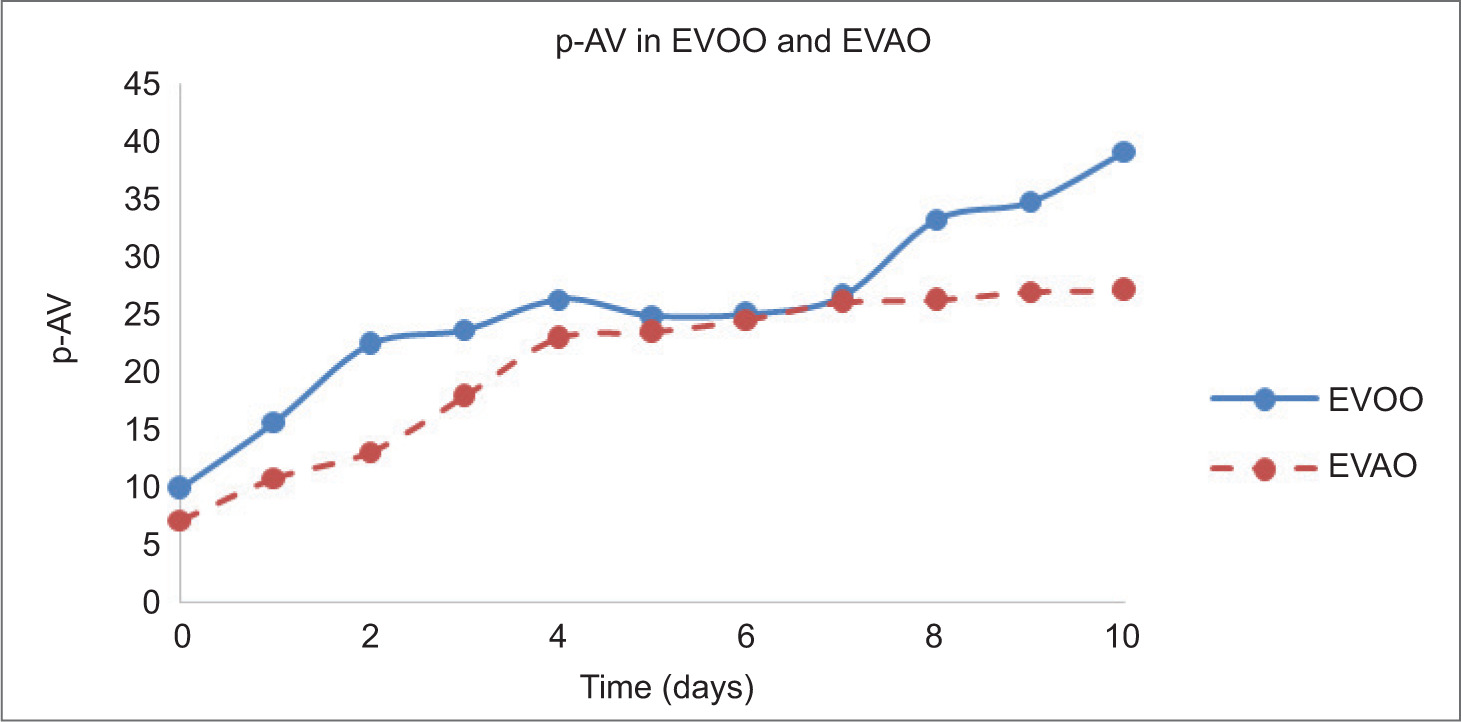
In addition to PV and because of its instability, it is necessary to measure other more robust parameters that account for thermal oxidation. p-AV, in addition to quantifying primary oxidation compounds, has the ability to quantify more stable secondary lipid oxidation compounds, such as ketones and aldehydes, providing a more complete picture of deterioration (Leong et al., 2015). Figure 4 shows the behavior of p-AV for EVAO and EVOO during heat treatment, with initial p-AV value of 7.4% for EVOO and 10.1% for EVAO. Then a sustained growth of p-AV was observed up to 10th day of processing, reaching an increased value of 298.6% and 219.8% for EVOO and EVAO, respectively. Both curves present a similar linear fit, with respective slope values of 3.94 and 3.49 for EVOO and EVAO. Coefficient of determination, r2 was 0.94 and 0.92 for EVOO and EVAO, respectively; r2 is an important predictor of thermal deterioration. Other investigations applied conventional and microwave heat treatments to soybean and corn oils and showed increased r2, ranging from 24.83% to 580% (Naz and Saeed, 2019).
Figure 4. p-Anisidine (p-AV) index during the processing period of EVOO and EVAO.
The TOTOX value is an indicator of total deterioration of fats and oils. This index links peroxide value to p-AV value, providing total information on the primary and secondary oxidation products formed (Shahidi and Wanasundara, 2002). This indicator has had adequate correlations with other parameters of deterioration of fats such as the induction time of the Rancimat methodology (Arabsorkhi et al., 2023). Subramanian et al. (2000) showed that a good quality vegetable oil has a TOTOX value of <4. In the present study, TOTOX value for EVOO was 17.4–50.3 and 13.7–32.6 for EVAO. This demonstrated that both oils were more oxidized due to thermal treatment, compared with the initial redox activity. Other studies showed an increase in primary and secondary oxidation compounds along with incremental changes in physical parameters, such as viscosity, during frying processes. This was due to the polymerization reactions that highly deteriorated lipids undergo (Liu et al., 2024).
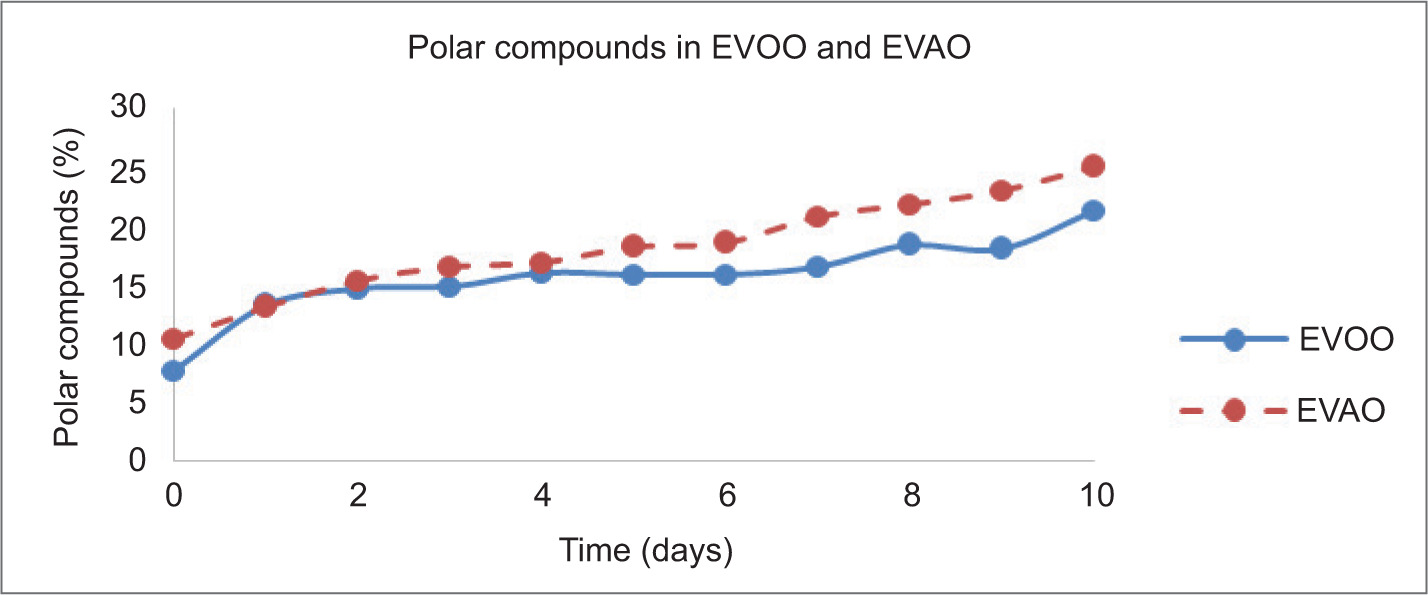
Figure 5 shows the evolution of PCs in both oils subjected to frying. PCs increased with increase in frying cycles for both oils. In the case of EVAO, the initial PC value was 10% and was 25% on the 10th day of processing. For EVOO, the initial PC value was 7.4% and was 22.3% on the 10th day of processing. On the other hand, the smoke point of EVOO and EVAO was high (>200°C for both oils). This demonstrated good stability at high temperatures, and thus low production of PCs under deterioration conditions, compared to less stable oils (Betancur et al., 2017; Yousif and Shakir, 2023). However, PCs depend on both fatty acid composition and presence of minor compounds that help in the protection of oils.
Figure 5. Evolution of polar compounds (PCs) during the processing period of EVOO and EVAO.
Unrefined oils usually have higher PC and acidity values, compared to refined oils, due to production process and not subjected to refinery process. PCs are well correlated during extensive deterioration processes; hence, it is considered as a robust parameter in the monitoring of deteriorated oils (Azpillicueta and Remirez, 1991). Additionally, the hydroperoxides formed can, because of frying medium, form alkoxy radicals, which, by means of a β-cleavage mechanism, form compounds of lower molecular weight (aldehydes) together with other free radicals. This results in a loss of mass of frying medium and continuation of degradation reactions (Wang et al., 2023). Therefore, when considering sanitary regulations, PC is an important criterion for ruling out the use of oils in the deep frying processes (Flores et al., 2018; Holgado et al., 2021; Sánchez-Muniz et al., 2008).
On the 10th day of this study, EVAO reached the maximum value allowed and EVOO attained a slightly lower value, despite the fact that at the end of processing, total phenolic compounds were found in a much lower proportion in EVOO than in EVAO (<20%). It was shown that in different thermal processes, the stability of vegetable oils strongly depends on the fatty acid profile, with high MUFA contents favoring stability in thermal deterioration processes (Flores et al., 2021; Forero-Doria et al., 2017; Flores-García et al., 2018). Additionally, the frying process impacts the quality of lipid fraction in fried food and is related to the migration of components. Therefore, it is essential to control the level of deterioration in order to maintain quality. The migration and/or transfer of components from the frying medium to the food could be related to oil degradation, leading to toxic effects on health, as well as the beneficial components present in unrefined oils such as case of EVAO and EVOO (Flores et al., 2018; Samaniego-Sanchez et al., 2021). Deep frying with unrefined oils requires special care regarding the content of unsaponifiable components, because it is observed that during the initial days of frying, there is nutritional enrichment and improvement of fried foods (Alves de Carvalho et al., 2022). However, compared to the current study, few studies are conducted on the limit of quality parameters of highly monounsaturated unrefined edible vegetable oils (Feitosa et al., 2019).
The study of functional groups present in EVOO and EVAO was done with an FTIR spectrometer (Figure 6). It was observed that the global distribution of signals complies with the patterns of an edible vegetable oil and no signals attributable to contamination by exogenous substances in lipid matrices were observed (He et al., 2023). Although different oil spectra presented minimal differences, a weak signal at 1510 cm–1 was present prior to the frying process (ti) but not present at the end of frying process (tf) in both EVOO and EVAO. This signal may correspond to the stretching vibration of aromatic C=C, thus related to the presence of natural aromatic compounds, such as tocols (tocopherols and tocotrienols), at the beginning of frying process. Peaks at 3006 cm–1 and 1648 cm–1 are common in vegetable oils and correspond to the stretching vibration of =CH and C=C, respectively, related to the presence of unsaturated fatty acids in EVOO and EVAO (Han et al., 2020). At 1745 cm–1, an intense signal corresponding to ester functional group of triacylglycerides was observed (Chauhan et al., 2015). In the 1459 cm–1 band, it matched the anti-symmetric C-H stretching vibration, which indicated the presence of methyl esters in oils (He et al., 2023). Peak signals at 1160 cm–1 and 1095 cm–1 were associated with asymmetric and symmetric stretching vibration of C-O-C, respectively, which indicated the presence of ester groups, characteristic of vegetable oils (Gu et al., 2019). Finally, all oil samples exhibited absorption band of 721 cm–1 associated with C-H bond of long chain alkanes (He et al., 2023).
Figure 6. FTIR analysis of EVOO and EVAO at initial (ti) and final time (tf).
Conclusions
EVAO contains a high percentage of MUFAs and a low proportion of PUFAs, which favors its stability against thermal and hydrolytic deterioration, even providing nutritionally beneficial compounds to frying medium. It was shown that both vegetable oils are suitable for domestic frying processes, with generation of oxidation and hydrolysis due to increased periods of frying sessions. 50 for EVOO and 40 for EVAO with at least 10 days in used at the total, which could be carried out without exceeding the limit of PCs (25%) established by the health regulations of many countries. On the other hand, several countries are recognized producers of avocado fruit (Mexico, New Zealand, Chile, South Africa, and Spain); they positively value the possible applications of EVAO, taking into account that the oil is extracted from avocado fruit.
In the case of EVOO, its good behavior at high temperatures is widely recognized. Its main producing countries (Spain, Italy, Greece, and Turkey) could positively value its domestic applications in frying processes in order to reach more consumers. Performance of both oils could have a positive impact on consumers, in the sense that the deep frying processes of unrefined oils, involves the contribution of substances of high nutritional value, especially those present in unsaponifiable fraction, whose behavior could be part of future research.
Acknowledgements
Dr. Marcos Flores thanks the research funding through the Fondecyt project 1230491 granted by the National Agency for Research and Development (ANID-Chile). Ministry of Science, Government of Chile.
Data Availability Statement
Data is available under request.
Conflicts of Interest
The authors declared no conflict of interest.
REFERENCES
Abril, D., Mirabal-Gallardo, Y., González, A., Marican, A., Durán-Lara, E.F., Silva Santos, L., and Valdés, O., 2019. Comparison of the oxidative stability and antioxidant activity of extra-virgin olive oil and oils extracted from seeds of c olliguaja integerrima and c ynara cardunculus under normal conditions and after thermal treatment. Antioxidants 8: 470. 10.3390/antiox8100470
Aladedunye, F., 2011. Inhibiting thermo-oxidative degradation of oils during frying. Lethbridge, Alta (ed.). Dept. of Chemistry and Biochemistry, University of Lethbridge, Lethbridge, Canada. https://hdl.handle.net/10133/3257
Alves de Carvalho, A.G., Olmo-García, L., Antunes Gaspar, B.R., Carrasco-Pancorbo, A., Castelo-Branco, V.N., and Guedes Torres, A., 2022. Evolution of the metabolic profile of virgin olive oil during deep-frying: assessing the transfer of bioactive compounds to the fried food. Food Chemistry 380: 132205. 10.1016/j.foodchem.2022.132205
Arabsorkhi, B., Pourabdollah, E., and Mashadi, M., 2023. Investigating the effect of replacing the antioxidants ascorbyl palmitate and tocopherol instead of TBHQ on the shelf life of sunflower oil using temperature accelerated method. Food Chemistry Advances 2: 100246. 10.1016/j.focha.2023.100246
Asokapandian, S., Swamy, G., and Hajjul, H., 2019. Deep fat frying of foods: a critical review on process and product parameters. Critical Reviews in Food Science and Nutrition 60: 3400–3413. 10.1080/10408398.2019.1688761
Aydınkaptan, E., and Mazi, I.B., 2017. Monitoring the physicochemical features of sunflower oil and French fries during repeated microwave frying and deep-fat frying. Grasas y Aceites 68: 1–12. 10.3989/gya.1162162
Azpillicueta, M.C.A., and Remirez, M.T.M., 1991. Estudio de la degradación de los aceites de oliva sometidos a fritura. I. Determinación estadística del parámetro que mejor cuantifica esta degradación. Grasas y Aceites 42: 22–32. 10.3989/gya.1991.v42.i1.1274
Betancur, D., Giraldo, L., and Cardozo, C., 2017. Extracción termomecánica y caracterización fisicoquímica del aceite de aguacate (Persea americana Mill. cv. Hass). Informador Técnico 81: 75–85. 10.23850/22565035.728
Chauhan, R., Chester, K., Khan, Y., Tamboli, E. T., and Ahmad, S., 2015. Characterization of Linum usitatissimum L. oil obtained from different extraction technique and in vitro antioxidant potential of supercritical fluid extract. Journal of Pharmacy and Bioallied Sciences 7: 284–288. 10.4103/0975-7406.168027
Christophoridou, S., Dais, P., Tseng, L.H., and Spraul, M., 2005. Separation and identification of phenolic compounds in olive oil by coupling high-performance liquid chromatography with post-column solid-phase extraction to nuclear magnetic resonance spectroscopy (LC-SPE-NMR). Journal of Agricultural and Food Chemistry 53: 4667–4679. 10.1021/jf040466r
Cheng, L., Wang, Q., Li, X., Huang, X., An, F., Luo, Z., Wang, J., Zeng, Q., Shang, P., Liu, Z., and Huang, Q., 2024. Exploring the influence and mechanism of different frying methods on the flavor quality of low-salt sour meat. Food Chemistry: X 23: 101591. 10.1016/j.fochx.2024.101591
Correa, K.L., de Carvalho-Guimarães, F.B., Mourão, E.S., Oliveira Santos, H.C., da Costa Sanches, S.C., Lamarão, M.L.N., et al. 2024. Physicochemical and nutritional properties of vegetable oils from Brazil diversity and their applications in the food industry. Foods 13: 1565. 10.3390/foods13101565
Dobarganes, M.C., and Márquez-Ruiz, G., 2007. Formation and analysis of oxidized monomeric, dimeric and higher oligomeric triglycerides. In: Erickson M.D. (ed.) Deep frying: chemistry, nutrition and practical applications. American Oil Chemists’ Society Press, Champaign, IL, pp. 87–110.
Farhoosh, R., Kenari, R.E., and Poorazrang, H., 2009. Frying stability of canola oil blended with palm olein, olive, and corn oils. Journal of the American Chemical Society 86: 71–76. 10.1007/s11746-008-1315-x
Fatemi, S.H., and Hammond, E.G., 1980. Analysis of oleate, linoleate and linolenatehydroperoxides in oxidized ester mixtures. Lipids 15: 379–385. 10.1007/BF02533555
Fedko, M., Siger, A., Szydłowska-Czerniak, A., Rabiej-Kozioł, D., Tymczewska, A., Włodarczyk, K., and Kmiecik, D., 2024. The effect of high-temperature heating on amounts of bioactive compounds and antiradical properties of refined rapeseed oil blended with rapeseed, coriander and apricot cold-pressed oils. Foods 13: 2336. 10.3390/foods13152336
Feitosa, S., Boffo, E.F., Batista, C.S.C., Velasco, J., Silva C.S., Bonfim, R., and Almeida, D.T. 2019. A real case study on the physicochemical changes in crude palm oil (Elaeis guineensis) during the deep-frying of akara, traditional cowpea-paste balls, in Brazil. Grasas y Aceites 70: 1–9. 10.3989/gya.0703182
Flores-García, M., Vergara, C.E., Forero-Doria, O., Guzmán, L., and Perez-Camino, M.C., 2019. Chemical evaluation and thermal behavior of Chilean hazelnut oil (Gevuina avellana Mol) a comparative study with extra virgin olive oil. European Food Research and Technology 245: 1021–1029. 10.1007/s00217-018-3206-1
Flores, M., Meyer, L., Orellana, S., Saravia, C., Galdames, C., and Perez-Camino M.C., 2018. Quality of lipid fractions in deep-fried foods from street vendors in Chile. Journal of Food Quality 7878439: 1–8. 10.1155/2018/7878439
Flores, M., Reyes-García, L., Ortiz-Viedma, J., Romero, N., Vilcanqui, Y., Rogel, C., Echeverría, J., and Forero-Doria, O., 2021. Thermal behavior improvement of fortified commercial avocado (Persea americana Mill.) oil with maqui (Aristotelia chilensis) leaf extracts. Antioxidants 10: 664. 10.3390/antiox10050664
Flores, M., Saravia, C., Vergara, C.E., Avila, F., Valdés, H., and Ortiz-Viedma, J., 2019. Avocado oil: characteristics, properties, and applications. Molecules 24: 2172. 10.3390/molecules24112172
Food and Agriculture Organization (FAO). Producciónmundial de aguacate 2020. Available at: https://www.fao.org/faostat/es/#data/QCL/visualize (accessed 17 March 2024).
Forero-Doria, O., Flores-García, M., Vergara, C., and Guzmán, L., 2017. Thermal analysis and antioxidant activity of oil extracted from pulp of ripe avocados. Journal of Thermal Analysis and Calorimetry 130: 959–966. 10.1007/s10973-017-6488-9
Gómez-Alonso, S., Salvador, M.D., and Fregapane, G., 2002. Phenolic compounds profile of cornicabra virgin olive oil. Journal of Agricultural and Food Chemistry 50: 6812–6817. 10.1021/jf0205211
Gu, L.B., Zhang, G.J., Du, L., Du, J., Qi, K., Zhu, X.L., Zhang, X.Y., and Jiang, Z.H., 2019. Comparative study on the extraction of Xanthocerassorbifolia bunge (yellow horn) seed oil using subcritical n-butane, supercritical CO2, and the soxhlet method. Food Science and Technology (LWT) 111: 548–554. 10.1016/j.lwt.2019.05.078
Han, J., Sun, R., Zeng, X., Zhang, J., Xing, R., Sun, C., and Chen, Y., 2020. Rapid classification and quantification of camellia (Camellia oleifera Abel.) oil blended with rapeseed oil using FTIR-ATR spectroscopy. Molecules 25: 2036. 10.3390/molecules25092036
He, J.H., Lin, D., Lin, S.Z., Wu, X.H., Lin, S.H., and Chen, X.J., 2023. Quality comparison of camellia (Camellia oleifera C. Abel) seed oil with different extraction methods. International Food Research Journal 30: 182–192. 10.47836/ifrj.30.1.15
Holgado, F., Ruiz-Méndez, M.V., Velasco, J., and Márquez-Ruiz, G., 2021. Performance of olive-pomace oils in discontinuous and continuous frying. Comparative behavior with sunflower oils and high-oleic sunflower oils. Foods 10: 3081. 10.3390/foods10123081
Hurtado-Fernández, E., Carrasco-Pancorbo, A., and Fernández-Gutiérrez, A., 2011. Profiling LC-DAD-ESI-TOF MS method for the determination of phenolic metabolites from avocado (Persea americana). Journal of Agricultural and Food Chemistry 59: 2255–2267. 10.1021/jf104276a
Jemai, H., Bouaziz, M., and Sayadi, S., 2009. Phenolic composition, sugar contents and antioxidant activity of Tunisian sweet olive cultivar with regard to fruit ripening. Journal of Agricultural and Food Chemistry 57: 2961–2968. 10.1021/jf8034176
Kapoor, B., Kapoor, D., Gautam, S., Singh, R., and Bhardwaj, S., 2021. Dietary polyunsaturated fatty acids (PUFAs): uses and potential health benefits. Current Nutrition Reports 10: 232–242. 10.1007/s13668-021-00363-3
Kosińska, A., Karamać, M., Estrella, I., Hernández, T., Bartolomé, B., and Dykes, G.A., 2012. Phenolic compound profiles and antioxidant capacity of Persea americana Mill. peels and seeds of two varieties. Journal of Agricultural and Food Chemistry 60: 4613–4619. 10.1021/jf300090p
Leong, X.F., Ng, C.Y., Jaarin, K., and Mustafa, M.R., 2015. Effects of repeated heating of cooking oils on antioxidant content and endothelial function. Austin Journal of Pharmacology and Therapeutics 3: 1–7. Available at: https://austinpublishinggroup.com/pharmacology-therapeutics/fulltext/ajpt-v3-id1068.pdf (accessed 22 January 2024).
Li, X., Wu, G., Yang, F., Meng, L., Huang, J., Zhang, H., Jin, Q., and Wang, X., 2018. Influence of fried food and oil type on the distribution of polar compounds in discarded oil during restaurant deep frying. Food Chemistry 272: 12–17. 10.1016/j.foodchem.2018.08.023
Liu, C., Wang, N., Wu, D., Wang, L., Zhu, X., and Yu, D., 2024. The effect of the fatty acid composition of fried oil on the oil-absorbing capacity of tofu puffs. Food Science and Technology (LWT) 203: 116406. 10.1016/j.lwt.2024.116406
Menz, G., and Vriesekoop, F., 2010. Physical and chemical changes during the maturation of Gordal sevillana olives (Oleaeuropaea L., cv. Gordal sevillana). Journal of Agricultural and Food Chemistry 58: 4934–4938. 10.1021/jf904311r
Moura, M.D.S., Da Silva, C.A.M., and Braga, M.B., 2023. Flaxseed and avocado oil blends: physical and physicochemical characterization, nutritional quality and oxidative stability. Applied Food Research 3: 100370. 10.1016/j.afres.2023.100370
Naz, S., and Saeed, R., 2019. Effect of heating on the oxidative stability of corn oil and soybean oil. Grasas y Aceites 70: e303. 10.3989/gya.0698181
Oppong, D., Panpipat, W., Cheong, L.-Z., and Chaijan, M., 2021. Comparative effect of frying and baking on chemical, physical, and microbiological characteristics of frozen fish nuggets. Foods 10: 3158. 10.3390/foods10123158
Ourrach, I., Rada, M., Pérez-Camino, M.C., Benaissa, M., and Guinda, Á., 2012. Detection of argan oil adulterated with vegetable oils: new markers. Grasas aceites [Internet]. 2012 Dec. 30 [cited 2024Oct.24]; 63(4):355–64. Available from: https://grasasyaceites.revistas.csic.es/index.php/grasasyaceites/article/view/1389
Pérez-Cordoba, R., Quesada-Granados, J.J., Ramírez-Anaya, J.P., Pena-Díaz, J., Blanca-Herrera, R., and Samaniego-Sánchez, C., 2023. Bioactive compounds in Spanish extra virgin olive oils: migration and stability according to the culinary technique used. Food Research International 172: 113191. 10.1016/j.foodres.2023.113191
Rodríguez, G., Squeo, G., Estivi, L., Quezada Berru, S., Buleje, D., Caponio F., Brandolini A., and Hidalgo, A., 2021. Changes in stability, tocopherols, fatty acids and antioxidant capacity of sachainchi (Plukenetia volubilis) oil during French fries deep-frying. Food Chemistry 340: 127942. 10.1016/j.foodchem.2020.127942
Samaniego-Sánchez, C., Martín-del-Campo, S.T., Castañeda-Saucedo, M.C., Blanca-Herrera, R.M., Quesada-Granados, J.J., and Ramírez-Anaya, J.d.P., 2021. Migration of avocado virgin oil functional compounds during domestic cooking of eggplant. Foods 10: 1790. 10.3390/foods10081790
Sánchez-Muniz FJ, Bastida S, Márquez-Ruiz G., and Dobarganes C., 2008. Effects of heating and frying on oil and food fatty acids. In: Chow C.K. (Ed.) Fatty acids foods and their implications. Taylor and Francis, Boca Raton, FL, pp. 511–543.
Santos, J.C.O., Dos Santos, I.M.G., De Souza, A.G., Prasad, S., and Dos Santos, A.V., 2002. Thermal stability and kinetic study on thermal decomposition of commercial edible oils by thermogravimetry. Journal of Food Science 67: 1393–1398. 10.1111/j.1365-2621.2002.tb10296.x
Satriana, Maulida, A., Qardhawi, R., Syamsuddin, Y., and Supardan, M.D., 2024. Effect of refining process on some quality attributes of screw-pressed avocado oil. South African Journal of Chemical Engineering 50: 20–26. 10.1016/j.sajce.2024.07.003
Shahidi, T., and Wanasundara, U., 2002. Methods for measuring oxidative rancidity in fats and oils. In: Akoh, C.C., and Mind, D.B. (eds.) Food lipids, chemistry, nutrition and biotechnology. EEUU, New York, NY.
Stier, R.F., 2004. Frying as a science–an introduction. European Journal of Lipid Science and Technology 106: 715–721. 10.1002/ejlt.200401065
Subramanian, R., Nandini, K.E., Sheila, P.M., Gopalakrishna, A.G., Raghavarao, K.S.M.S., Nakajima, M., Kimura, T., and Maekawa, T., 2000. Membrane processing of used frying oils. Journal of the American Chemical Society 77: 323–328. 10.1007/s11746-000-0052-2
Tan, C.X., 2019. Virgin avocado oil: an emerging source of functional fruit oil. Journal of Functional Foods 54: 381–392. 10.1016/j.jff.2018.12.031
Touffet, M., Allouche, M.H., Ariane, M., and Vitrac, O., 2021. Coupling between oxidation kinetics and an isothermal oil flow during deep-fat frying. Physics of Fluids 33: 85105, pp. 1–25. 10.1063/5.0055873.
Xu, T.T., Li, J., Fan, Y.W., Zheng T.W., and Deng, Z.Y., 2015. Comparison of oxidative stability among edible oils under continuous frying conditions. International Journal of Food Properties 18: 1478–1490. 10.1080/10942912.2014.913181
Téllez-Morales, J.A., Rodríguez-Miranda, J., and Aguilar-Garay, R., 2024. Review of the influence of hot air frying on food quality. Measurement: Food 14: 100153. 10.1016/j.meafoo.2024.100153
Tsai, Y., Chiang, D., Li, Y., Perng, T., and Lee, S., 2023. Thermal degradation of vegetable oils. Foods 12: 1839. 10.3390/foods12091839
Wang, D., Xiao, H., Lyu, X., and Chen, H., 2023. Lipid oxidation in food science and nutritional health: a comprehensive review. Oil Crop Science 8: 35–44. 10.1016/j.ocsci.2023.02.002
Yousif, M., and Shakir, H., 2023. A comparison of some physical and chemical characteristics of two local and seven introduced cultivars of olives oleaeuropaea. IOP Conference Series: Earth and Environmental Science 1262: 032043. 10.1088/1755-1315/1262/3/032043
Zhang, Q., Saleh, A.S., Chen, J., and Shen, Q., 2012. Chemical alterations taken place during deep-fat frying based on certain reaction products: a review. Chemistry and Physics of Lipids 165: 662–681. 10.1016/j.chemphyslip.2012.07.002
Zheng, Y., Fang, Y., Xu, X., Ye, W., Kang, S., Yang, K., et al. 2023. Dietary saturated fatty acids increased all-cause and cardiovascular disease mortality in an elderly population: the national health and nutrition examination survey. Nutrition Research 120: 99–114. 10.1016/j.nutres.2023.10.002